From Clean Hypervisor to Corp-Grade Bare Metal in an Afternoon
We took a freshly provisioned bare-metal hypervisor and turned it into a hardened, monitored, VPN-connected production host in a single afternoon. An AI agent handled the tedious verification; a human held authority over every irreversible step.

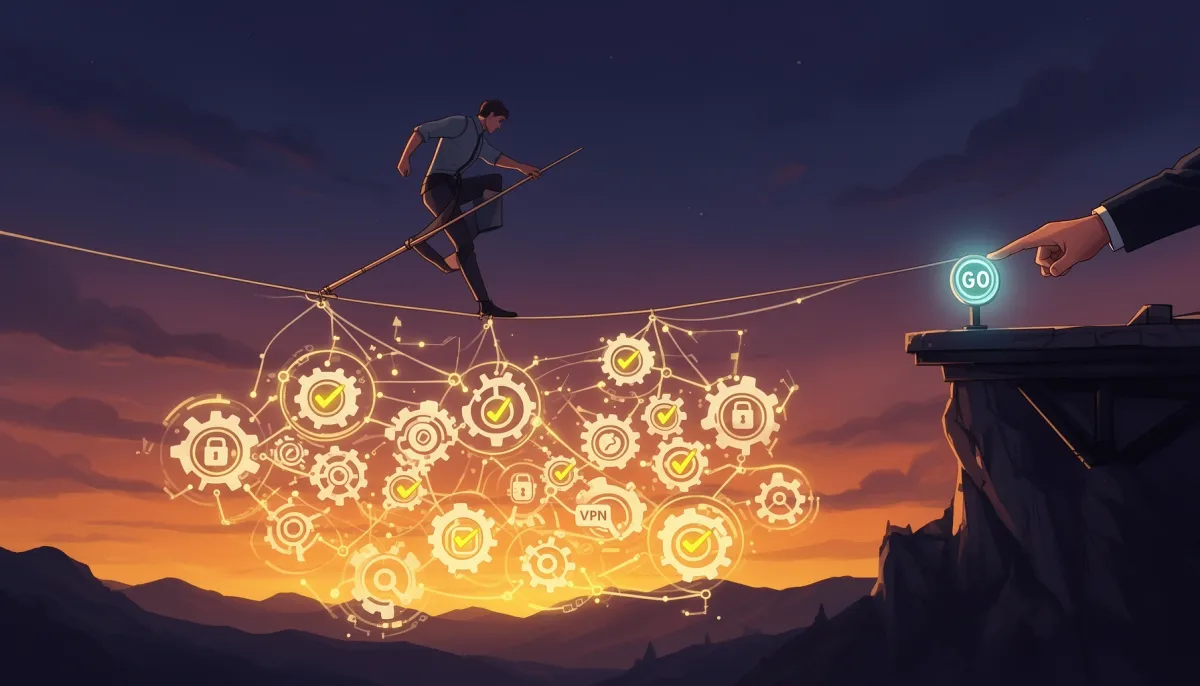
TL;DR. We took a freshly provisioned bare-metal hypervisor and turned it into a hardened, monitored, VPN-connected production host in a single afternoon, using an AI agent as a tireless junior operator and a human as the only one allowed to approve irreversible steps. The result was corp-grade infrastructure with no scary moments. The lesson: an AI agent lets a careful operator move at the speed of a reckless one, while staying careful.
A recent AIpster piece argued that the real value of an AI command-line tool isn't autonomy. It's leverage under control. The author ran a high-stakes database migration not by treating the CLI as a code generator, but as a tireless junior operator working a disciplined checklist while a human kept authority over every irreversible step. Written plan, adversarial review, confirmed backups, a full rehearsal on a throwaway copy, data verified rather than assumed. The migration cost only a handful of minutes of downtime.
We wanted to know if that same division of labor held up for a messier job. Not a single surgical migration, but the multi-front work of taking a raw bare-metal server and turning it into something we'd trust with production. The kind of build that's normally a long, error-prone day of copy-pasting commands, forgetting one flag, and finding out three steps later.
The starting line
What the provider hands you is deliberately minimal. A current hypervisor distribution on a recent Linux base, a RAID mirror across two spinning disks, a large pool of fast local storage already laid down, and a public interface bridged and ready. A few defaults arrive pre-installed: a basic brute-force jailer with no real policy, key-only SSH on the standard port, a mail transfer agent nobody asked for, and the detail that bites people, automatic unattended upgrades switched on.
It boots. It's reachable. It's also nowhere near ready to hold anything that matters. No off-box backup. No intrusion policy worth the name. No monitoring, no alerting, no segmented internal network, no tunnel to the office. The firewall is technically present, but it isn't expressing any intent we actually decided on.
The goal was to close every gap without ever ending up in a spot where a single fat-fingered command could take the box offline, or worse, take it offline and leave us unsure how to get back.
How we worked
The working agreement mirrored the AIpster framing almost exactly. The human set direction: what to build, in what order, and which trade-offs were acceptable. The agent did the reading, the sequencing, the drafting of configs and scripts, and the relentless verification that humans get bored of around the third repetition. Anything irreversible or shared (applying a network change live, flipping a firewall default to drop, disabling the existing protection in favor of a new one) was staged, explained, and only then executed with explicit human sign-off.
There was a hard environmental constraint too, and in hindsight it reinforced the whole philosophy. The agent ran inside a restricted jail where some basic shell plumbing simply wasn't available, so a lot of blind commands failed outright. Rather than fight it, we leaned in. The agent proposed and drafted. For the genuinely stateful operations (storage, mounts, service state, live networking), a human ran the command and pasted back the truth of what the system actually did. It was a feature disguised as a limitation. It forced a checkpoint at exactly the moments where checkpoints matter.
Building it out
Storage and data layout came first, because everything else sits on top of it. We carved the big local pool into purpose-built datasets: one for container engine internals, one for the stacks themselves, separate homes for databases, bulk storage, backups, temp, and images. Compression was tuned per dataset, a heavier high-ratio algorithm on cold write-once data and a lighter latency-friendly one on the things that need to stay quick. Memory used for filesystem caching was capped so the cache could never starve the workloads it was meant to accelerate.
Then we hardened the front door. SSH moved off the default port, and the access policy was set deliberately rather than inherited. Kernel-level network and memory tunables landed as a single reviewed file instead of a scattering of one-off changes. One small but meaningful decision was made explicit and recorded: automatic unattended upgrades were turned off. On a production box, packages installing themselves in the background is a risk vector, not a convenience. We kept the package lists refreshing so an operator always sees what's available, but the act of upgrading stays a human choice.
Backups were treated as a precondition, not an afterthought. Off-box cold storage was mounted, and three coordinated jobs were written: one for the system and its configuration, one for the application stacks (quiescing each one cleanly so the captured state is consistent), and one that replicates the local copies out to the cold store. Each job reports its outcome by email, success or failure, with sizes and durations. Silence is never mistaken for health.
That last point drove the alerting work. The disk array monitor, the drive SMART daemon, and the storage pool's event daemon were all wired to a single outbound mail path. Then, critically, we tested each one by firing a real test alert and confirming delivery. The pre-installed mail agent that conflicted with our own plans was removed and replaced with a lightweight relay. This is the prove-it-don't-assume-it discipline from the migration story, applied to monitoring. An alerting system you've never seen fire is just a hopeful comment in a config file.
Automatic point-in-time snapshots went on next, with retention tiers matched to how precious each dataset is: frequent and long-lived for critical application data, moderate for general workloads, sparse for the things that are themselves backups. Snapshots aren't backups, but they're the cheapest possible undo button, and on this filesystem they're nearly free.
Connecting to the office
A production host that only exists on the public internet is a host you can only ever manage from the public internet. We didn't want that. We stood up an internal-only bridge for future local workloads, then built an encrypted point-to-point tunnel back to the office network.
This was the part that behaved most like a real operation, with all the small frictions documentation never warns you about. The first handshake refused to complete. A subnet mask on the remote end was wrong. There was an address conflict because the office already used the range we'd reached for. A keepalive setting was missing on one side. The remote gateway was silently forcing traffic onto the wrong path, and a separate quirk in how it handled certain redirects had to be neutralized at the kernel level.
None of these were dramatic. None of them were guessable up front. They were exactly the read-the-system, adjust, re-test loop the AIpster author describes, the work that's tedious for a human and well-suited to an agent that never gets impatient on the eleventh attempt. By the end the tunnel was up, traffic flowed both ways, and a machine on the office LAN could reach across to the server and back.
Locking the perimeter
With services taking shape, we set the firewall to express actual intent. The default for inbound traffic became drop. The office network got full access. Only the handful of ports that genuinely needed to face the public were opened, and one sensitive service was scoped so it only listened where it was supposed to. Management interfaces were deliberately not exposed to the world, reachable from the office tunnel and invisible from everywhere else. The whole ruleset lived in a single script so it could be reasoned about as one artifact, and it was made to survive reboots.
The flip to a default-drop policy is precisely the kind of irreversible-feeling action that deserves a human in the loop, and it got one. We confirmed the live session would survive the change before committing to it, and only then persisted the rules.
Trading reactive defense for something smarter
The last major piece was swapping the inherited brute-force jailer for a modern, community-fed intrusion detection and prevention system. We chose to replace rather than run both, since two tools banning the same offenders is a recipe for confusion. Before enabling any blocking, trusted addresses were whitelisted so we couldn't possibly lock ourselves out, the operational equivalent of testing the parachute before the jump. The new enforcement component was integrated with the firewall so its bans actually bite, and the startup ordering was pinned so that on a cold boot the layers come up in the right sequence rather than racing each other.
Throughout, the old tool's configuration was left in place, disabled but intact. If the new system misbehaved, rolling back was a one-line operation, not an archaeology project. That's the reversibility principle made concrete. You don't delete the old thing the moment the new thing seems to work. You keep the door open until you're sure.
The lesson that only showed up under load
The most instructive moment wasn't a security control at all. It was a backup that ran absurdly slowly. The naive read was "the cold storage link is slow," and an earlier, lazier conclusion had said exactly that. The real cause, found by actually measuring instead of assuming, was subtler. The remote storage is excellent at absorbing one large file pushed in bulk and terrible at a stream of many tiny incremental writes, because each small write pays a full network round-trip.
The fix was architectural rather than a tuning knob. Stage the backup locally where the fast filesystem can absorb the stream, then push the finished artifact in one bulk transfer. Throughput went from a crawl to fully saturating the link.
It's a small story, but it's the whole thesis in miniature. The wrong answer was plausible and would have survived a casual glance. The right answer required the unglamorous work of reproducing the problem, measuring both paths, and discarding a previously stated conclusion when the evidence contradicted it. That's operations work, and it's exactly where a patient agent paired with a skeptical human outperforms either one alone.
What we actually proved
By the end of the session the box was unrecognizable. Segmented storage with tuned compression and automatic snapshots. A hardened access surface. Tested multi-channel alerting. Layered backups reaching off-site. A private tunnel to the office. An intent-driven firewall closed by default on both address families. A modern intrusion-prevention layer integrated end to end. Corp-grade, in an afternoon.
But the headline isn't the speed. Plenty of tools can emit commands quickly. The headline is that we got there without a scary moment, no point where an undecided human stared at an irreversible action wondering if it was safe. Every dangerous step was rehearsed, scoped, reversible, or gated behind explicit approval, and the tedious verification that makes that possible was handled by something that doesn't get bored.
The frontier the AIpster piece points at isn't an AI that runs your infrastructure while you sleep. It's an AI that lets a careful operator move at the speed of a reckless one, while staying careful. That's what we felt here. The agent supplied tireless execution and an encyclopedic willingness to re-check its own work. The human supplied judgment, context, and the authority to say go, or not yet. Neither would have been enough alone. Together they turned a long, fraught day into a short, controlled one.
FAQ
What does it mean to use an AI agent as an operator instead of a code generator?
Using an AI agent as an operator means it handles the reading, sequencing, config drafting, and repetitive verification of an infrastructure build, while a human keeps authority over every irreversible step. The agent proposes and checks. The human decides and approves. This is different from a code generator, which just produces output you still have to operate yourself.
How long did it take to harden the bare-metal server?
The full build took a single working afternoon. In that session we went from a clean hypervisor to segmented tuned storage, hardened SSH, tested alerting, layered off-site backups, an office VPN tunnel, a default-drop firewall, and a modern intrusion-prevention layer. The speed came from the agent handling tedious verification, not from skipping safety steps.
Why turn off automatic unattended upgrades on a production server?
We turned them off because packages installing themselves in the background is a risk vector on a production box, not a convenience. We kept package lists refreshing so an operator can always see what updates are available, but the act of upgrading stays a deliberate human choice rather than an unattended event that could break a running service.
Why test alerts and backups instead of trusting the configuration?
Because an alerting system you've never seen fire is just a hopeful comment in a config file. We fired a real test alert through each monitoring channel and confirmed delivery, and we measured backup throughput rather than assuming it. The slow-backup problem proved the point: the plausible explanation was wrong, and only measurement revealed the real architectural cause.
What was the biggest performance lesson from the build?
The biggest lesson came from a backup that ran far too slowly. The assumed cause was a slow storage link, but measurement showed the real issue was many tiny incremental writes, each paying a full network round-trip. Staging the backup locally and pushing one bulk transfer saturated the link. The fix was architectural, and it only surfaced because we measured instead of guessing.
Local AI Playground
Real AI models running entirely in your browser. Your GPU, your data — nothing sent to a server.
Try it free