The Most Important AI Race Isn't the Frontier Anymore
Forget the flagship hype. The biggest AI disruption is happening in fast, affordable models that handle everyday work.


The gap between the best frontier model and the second-tier keeps grabbing attention, but for ordinary work that gap is shrinking fast. Benchmarks on LLMStats show that Qwen 3.6 35B A3B, released April 14, 2026, now matches or beats Claude Haiku 4.5 from October 15, 2025. Anthropic has shipped nothing new in that small, cheap tier since. For most daily tasks, you don't need a flagship. A good small model is already enough.
Where This Started: A Reddit Chart About the Top End
The user u/PetersOdyssey posted a thread on r/LocalLLaMA, showing a projection that the open-weight ecosystem should have something at the same level in about 24 months.
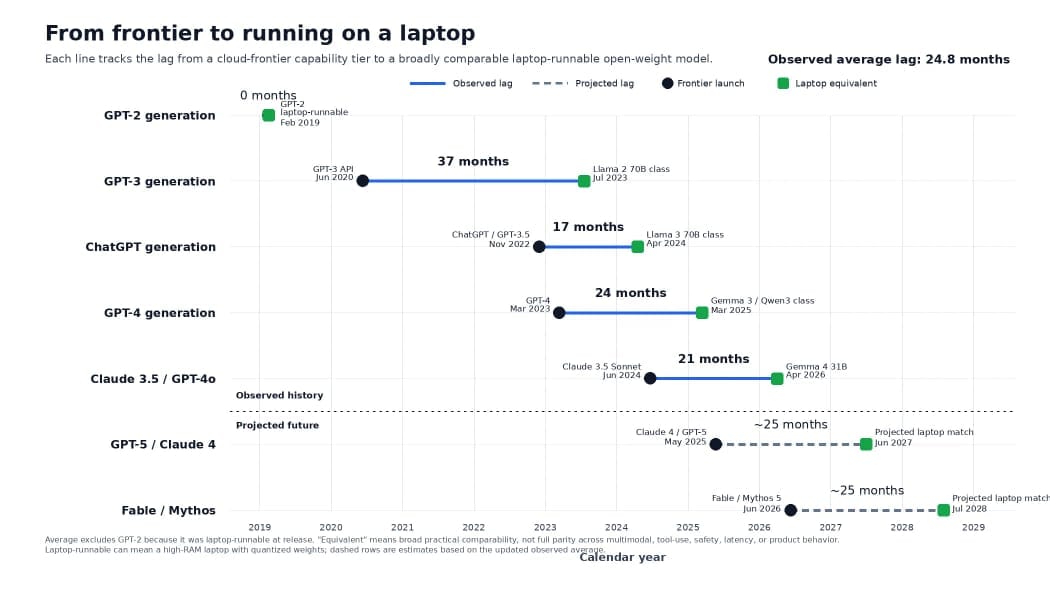
As I read through the discussion, it reminded me of something that, at the first glance, seems completely unrelated.
The Parkway of the Wealthy
A few years ago I watched a YouTube video (sadly, I don't have access to it anymore) of someone driving through one of São Paulo's wealthiest neighborhoods.
You'd expect every driveway to be filled with exotic cars. And indeed, there they were: Porsches, Land Rovers, BMW, and Mercedes Benz.
But that wasn't what surprised me.
Alongside those luxury cars, almost always there was some modest ones. Popular cars from makes such as Volkswagens, Fiat, Honda and Hyunday.
The explanation was simple: taking a Porsche to buy groceries or drop the kids off at school simply wasn't worth the extra cost. For those everyday errands, a Honda Civic did the job perfectly well.
That really hit the spot.
The Uncomfortable Truth About LLM
Browse LinkedIn for a few minutes and you'll see people showcasing Fable, GPT-5.6, or whatever the latest flagship happens to be. The demos are impressive, and the technology really is remarkable.
But ask yourself: how often does your work actually look like those demos?
I bet most of it are pretty mundane tasks. Using Fable to do that kind of work would be like driving a Ferrari to the post office. It would work? It surely would. Would it be efficient? Hell, no.
Most knowledge work isn't glamorous. It's summarizing documents, answering emails, translating text, explaining code, writing boilerplate, reviewing pull requests, extracting information, or implementing small features. These tasks don't require the absolute smartest model. They require a model that's good enough, fast enough, and cheap enough.
Meet the Hondas of the LLM World
You don't buy a semi-truck to pick up a gallon of milk.
The major AI labs know this. Every major closed-source frontier lab has some kind of small-tier offering. OpenAI has its "mini" series, Google relies heavily on Flash variants, and Anthropic's Haiku line keeps massive enterprise pipelines running affordably.
These aren't toys: they are highly optimized, hyper-efficient engines designed explicitly to handle the world's mundane data at scale.
People do real work with those little beasts.
But the real disruption isn’t happening behind corporate APIs. It’s happening in the open-weight ecosystem.
The interesting part is that these "daily drivers" are getting dramatically better every year. By combining multiple architecture techniques, open models have achieved a staggering feat: squeezing flagship-level reasoning into footprints small enough to run on commercial, local hardware.
And most important, they are taking way less time to catch up than 24 months.
Exhibit A: Alibaba's Qwen 3.6 family
If there is a poster child for this new generation of "Honda" models, it's Alibaba's Qwen 3.6 family.
Take Qwen 3.6 35B A3B. Released at 04-14-26, it is relatively large (a 35B model, would, in full precision, need about 70GB of ram for the weights alone). In practice, thanks to its Mixture-of-Experts (MoE) architecture, only about 3 billion parameters are active for each generated token. That means you get much of the knowledge and capability of a far larger model while paying a computational cost much closer to a 3B model.
⚠️ If you want to delve a little bit on the differences on models arquitectures, sign up for our upcoming article on model architectures (it is bound to be published in 07-20-26).
The result is remarkable. It delivers coding, reasoning, and multimodal performance that rivals models several times its effective size. It supports a native 262K-token context window, multimodal inputs, and was designed with agentic coding workloads in mind rather than simply maximizing benchmark scores.
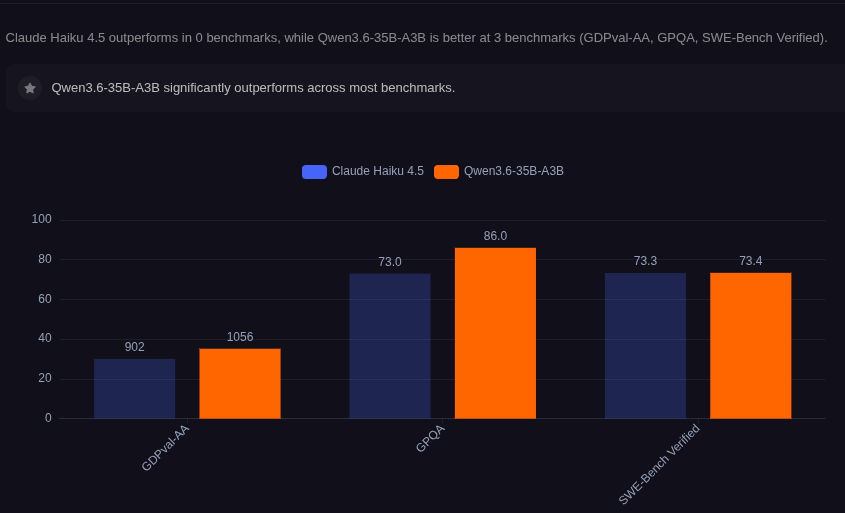
You may wonder how Qwen compares to an offering from a frontier lab. Let us look at Anthopic's Haiku 4.5. Released at 10-15-25, Haiku is, according to Anthropic, "our fastest model, a lightweight version of our most powerful AI, at a more affordable price".
Looking at llm-stats.com comparison. Qwen is superior to Haiku.
It is worth nothing that benchmarks should be taken with a grain of salt. While this is indeed true, benchmark remain useful for tracking broad capability trends across many tasks.
But perhaps the most important thig is that, unlike Haiku, Qwen is free. You don't need to rent someone else's API to benefit from it. You can download it, run it locally, fine-tune it, or integrate it into your own products.
💡 It is completely feasible to run Qwen in a pretty modest hardware. Check it out this YouTube video on how to run Qwen on a computer with 24Gb of RAM and 6gb of VRAM.
Exhibit B: Google's Gemma4 family
Alibaba isn't the only company proving that "small" no longer means "weak."
Google's released Gemma4 family in 04-02-26. It follows a very different philosophy from Qwen, yet arrives at the same conclusion. Rather than maximizing raw parameter count, Gemma focuses on squeezing as much capability as possible into models that are practical to deploy.
Take Gemma 26b a4b for instance, it also crushes Haiku in many benchmarks, while having about 75% of the size of Qwen.
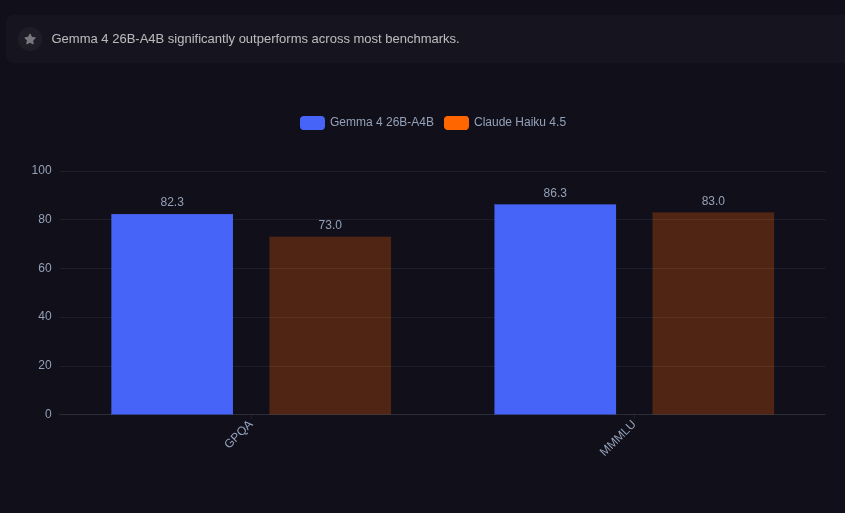
And yes, if you are wondering now, Gemma4 is also free.
The Aftermatch
When two independent open-weight families — Google's Gemma and Alibaba's Qwen — both reach this level of capability, it's much harder to dismiss the trend as a one-off breakthrough. It starts looking like the new normal.
But there is another thing. If you look at the release dates, it took way less than 24 months for open-weight models to surpass Haiku.
It took about 6 months.
And keep in mind that these models are not data-center behemoths. They are models you can run right now into your gaming rig.
Why Anthropic Went Quiet in the Small Tier
⚠️ This is a highly speculative view. I don't claim to have any inside information on Anthropic's strategy. Take this with a grain of salt.
Here's a detail I keep chewing on.
Since Haiku 4.5 in October 2025, Anthropic hasn't released a new model in that small, cheap class. We had at two iteratons of Sonnet (4.6 and 5.0), three iterations of Opus (4.6, 4.7, and 4.8), and the mighty Fable 5.
But no new Haiku version.
I can't read the room inside Anthropic, so treat what follows as an argument, not a leak. But I think the silence makes sense if you think about the incentives.
Building a strong small model is not free. You need to train it, evalute it and own (or rent) serving infrastructure. You do all that, you ship it, and within two quarters an open-weight release out of nothing surpass it. Your customers can now self-host something better, and your your differentiation in that tier becomes much harder to defend.
So why keep investing there?
If the cheap tier commoditizes, the rational move for a frontier lab is to concentrate spend where the moat still exists: the very top. That's where a few points of capability still command real money and real loyalty. The small tier becomes often not worth defending at all.
I think that's what we're watching. Not a failure to ship, but the realization that competing in that space is a bad trade.
The Part Practitioners Actually Feel
Strip away the benchmark drama and ask yourself a simple question.
What do you actually do with these models all day?
When I ask that myself, the list is boring:
- Summarize a document or a thread.
- Extract structured fields from messy text.
- Draft a first version of an email, a ticket reply, or a spec.
- Classify and route incoming messages.
- Answer a question against a known set of documents.
- Rewrite or clean up text I already have.
None of that needs a flagship. A competent small model handles the overwhelming majority of daily tasks at a fraction of the cost and latency. The frontier model is overkill for a summarizer the same way a race car is overkill for a school run.
The places where the frontier genuinely earns its price are narrower than the hype suggests: long-horizon agentic work, hard multi-step reasoning, tricky code across large contexts, and the messy edge cases where a small model quietly gets things subtly wrong. Those matter. They're just not most of the volume.
What This Means for How You Build
If the cheap tier is converging and the frontier labs are pulling back from it, a few practical moves follow.
Default to small, escalate to large: Route most traffic to a cheap, fast model and only bump the hard cases up to a frontier model. You'll cut cost dramatically and barely notice a quality difference on routine work.
Treat open weights as a real option, not a hobby: When an open model catches the commercial offerings within two quarters, self-hosting stops being a weekend project and becomes a legitimate cost and privacy decision.
Stop benchmarking against the summit: The right comparison for your use case is usually good enough, cheap, and fast, not the best of the world. Pick the models that clears your task's bar, not those that are on the spotlight.
Assume the small tier keeps getting cheaper: If frontier labs retreat from it and open models keep landing, the floor for acceptable quality drops toward free. Design your economics around that, not around today's API prices.
Back to the Reddit chart. Maybe the frontier really does hit some dramatic new capability on schedule. Maybe it slips. I genuinely don't know.
But here's my honest take. Even if the top of the curve keeps sprinting, the bottom of the curve is where your bill gets paid. The frontier race decides who gets the magazine cover. The quiet convergence in the cheap tier decides what your product costs to run and whether you need a vendor at all.
That second story gets almost no attention. It's the one I'd bet on.
FAQ
Is an open model like Qwen 3.6 35B A3B really as good as a commercial model?
Not as good as the absolute best frontier models, no. But Qwen 3.6 35B A3B, released April 14, 2026, matches or beats Claude Haiku 4.5 from October 15, 2025 on the kinds of everyday tasks that make up most real usage.
Why hasn't Anthropic released a new small model since Haiku 4.5?
Anthropic hasn't shipped a new model in that small, cheap tier since Haiku 4.5 on October 15, 2025. This is my argument, not confirmed strategy: when open-weight models catch the cheap tier within a couple of quarters, it stop making sense to invest into that tier.
Do I need a frontier model for daily work?
Usually not. Most daily tasks are summarizing, extracting, drafting, classifying, and answering questions over documents. A competent small model handles those at a fraction of the cost and latency. Reserve frontier models for long agentic tasks, hard reasoning, and complex code.
What's the smartest way to use both cheap and expensive models?
Default to a small, fast model for most traffic and escalate only the hard cases to a frontier model. This routing pattern cuts cost sharply while keeping quality high where it actually matters.
Local AI Playground
Real AI models running entirely in your browser. Your GPU, your data — nothing sent to a server.
Try it free