The AI Golden Age Has Passed, Welcome to the AI Golden Age
The first AI golden age was built on renting frontier model compute by the token. The second is built on local inference, small specialized models, and routing architecture that puts the right task on the cheapest capable model.


The first AI golden age sold magic: one giant model in the cloud, billed by the token, and you never asked what ran underneath. That era is ending. The second golden age is grounded. Local inference, small task-specific models, and diffusion-based generation are pushing intelligence onto your own hardware at a fraction of the cost. The hype is fading, and that is exactly why this gets good.
The First AI Golden Age
Let me say the uncomfortable part first. The version of AI we fell in love with in 2023 was never economically honest. It ran on subsidized by venture money. We treated intelligence as a metered utility, but nobody gave us the right price.
For years, the default answer to every problem was the same: call the largest frontier model through an API and pay per token. It was easy. It was beautiful. It was ground breaking.
But it was also wildly wasteful.
And the checks are coming due now.
What actually ended
The thing that ended is not progress. It's the illusion that bigger and remote is the only path. The majority of real-world LLM work is boring. It's summarization, classification, extraction, rewriting, and routing. None of that needs a 400-billion-parameter generalist trained to win math olympiads.
We were using a freight train to deliver a pizza.
The golden age of "don't worry about what's inside" is over. Good. That obliviousness was a luxury we paid for with margin we didn't have.
The economics flipped
The clearest signal of the shift is the move toward local inference, and the people running it are not hobbyists anymore.
Threads subreddits like r/LocalLLaMA have started arguing, with data, that economics are now shifting towards open and local inference having the best bang-for-the-buck in the intelligence per dollar ratio.
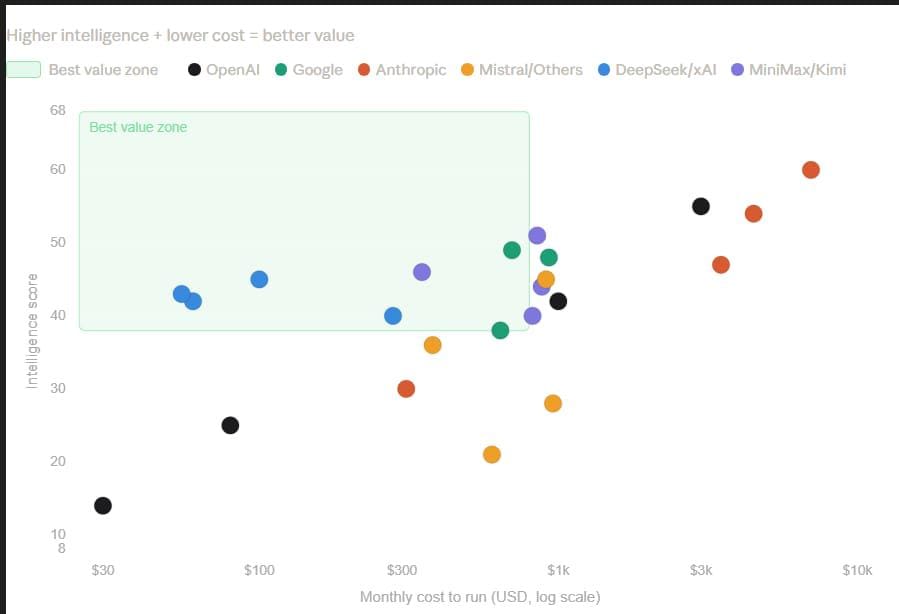
Think about what that does to the math for anything high-volume:
- A per-token API bill scales linearly with usage and never stops.
- A local model has a fixed upfront cost and then near-zero marginal cost.
- Open weights mean no vendor can deprecate the model you built your product on.
- Your data never leaves the building, which kills an entire category of compliance headaches.
The crossover point keeps moving in favor of local. As consumer GPUs get more memory and quantization gets better, the size of model you can run on a desk or a single server keeps climbing. The frontier labs are still ahead on raw capability. They are not ahead on cost per useful task, and cost per useful task is what businesses actually buy.
This is not future, this is reality.
You can, as of today (22th of June, 2026), download Qwen 3.6 35B A3B and run it own your own gaming desktop. Albeit not frontier, this little model is a best, outperforming Haiku 4.5 in coding tasks.
No token bills.
No quotas.
With a bonus being a good reason to upgrade to GTA 6 :)
Small models do the unglamorous work better than you'd think
While not enourmous as frontier models (whose parameter count may reach trillions of parameters), model like Qwen are still large.
There is another kind of player on this era. An underdog, that excel in doing specialized dirty work.
The Small Language Models -- SML -- enter the arena.
Take, for instance, summarization. A well-chosen small model can produces summaries that are good enough that a blind reader can't reliably tell it apart from the big-model output. For a task that narrow, the giant model's extra reasoning capacity is mostly idle weight you're paying for.
Capability and fitness are not the same thing. A frontier model is more capable in the abstract. A small model fine-tuned for your task is often more fit for the job, faster, cheaper, and private (you can look at our [playground]~(https://aipster.com/ai-playground/) to fiddle with SML running from inside your browser).
Where small models genuinely struggle is the hard stuff: multi-step reasoning, long-context synthesis, novel coding problems, anything that rewards a deep world model. So you stop treating one model as the answer to everything. You build a portfolio.
The sane architecture looks like a fleet, not a monolith:
- A tiny classifier decides what kind of request just arrived.
- Routine tasks (summarize, extract, tag, reformat) go to a small local model.
- Genuinely hard requests escalate to a large model, local or remote.
- You log everything and keep moving work down the stack as small models improve.
Most teams discover that 80 percent or more of their traffic never needs to escalate. That 80 percent is where the rented-token bill quietly eats your margin, and it's the first thing local inference reclaims.
Diffusion is the wildcard that makes small even cheaper
The third shift is the most technically interesting, and it's the one most people haven't priced in yet.
Nearly every language model deployed today is autoregressive: it generates one token, then the next, then the next. That sequential dependency is a hard speed block: generation of token number 500 literally cannot start until token 499 exists.
Google DeepMind labs released the Diffusion Gemma model. What make this worth noting is that this model is a diffusion language model - dLLM.
A dLLM work differently. Instead of writing left to right, they start from noise and refine the whole output in parallel over a series of steps. This is how image generation is done. Google DeepMind's Diffusion Gemma is a public example of this approach applied to text.
But why should you care ?
- Parallel refinement can cut the number of sequential steps needed to produce an output.
- Fewer sequential steps can mean lower latency and better hardware utilization.
- Better utilization means more useful work per watt, which is the metric that actually decides whether local inference is viable.
TL;DR; Diffusion models make your hardware produce more with the same amount of watts.
A word to the wise
Diffusion text models are early, the tooling is thin, and autoregression still wins on most quality benchmarks today. But the direction matters. If you can get comparable quality with a generation method that's structurally cheaper to run, that compounds directly with the local-and-small trend. Cheaper sampling on a small local model is the combination that pushes capable AI all the way down to the edge.
From magic to plumbing, and why that's the upgrade
Put the three trends together and you get a different picture of where this is going.
Local inference takes the cost out. Small specialized models take the waste out. Diffusion-style generation takes more compute out. None of these is a flashy demo. All of them make AI something you own and understand instead of something you rent and trust on faith.
The end user used to be oblivious by design: just "ask the magic box", they said. The new posture is grounded. You (should) know what model is running, where it lives, what it costs per task, and why you chose it. That sounds less romantic. It's the exact transition every real technology makes when it stops being a spectacle and starts being infrastructure.
Electricity went through this. So did the internet. The magic phase ends, the boring competent phase begins, and the boring phase is when the value actually reaches everyone.
What I'd do about it this year
If you're building with AI right now, the practical takeaways are concrete.
- Measure your task mix. Find out what fraction of your traffic is routine.
- Run a small model in production for one boring task. Do not use a Ferrari for doing groceries. A Toyota exists for a reason.
- Build a router, not a monolith. Cheap tasks down, hard tasks up.
The AI golden age that just ended was the age of awe. We needed it. It showed everyone what was possible. The age beginning now is the age of ownership, and it will quietly do far more useful work than the first one ever did.
Welcome to the AI golden age.
FAQ
Is the cloud AI era really over?
No, and that's not the claim. Frontier cloud models still lead on the hardest reasoning and coding tasks, and they aren't going away. What's ending is the assumption that renting one giant remote model per token is the right default for every workload. For high-volume, routine tasks, local and small now wins on cost, privacy, and control.
Are small language models actually good enough for production?
For narrow tasks, frequently yes. Summarization, classification, extraction, and reformatting are well within reach of small models, especially when fine-tuned on your own data. They fall short on multi-step reasoning and novel problem-solving, which is why the smart pattern is a router that escalates only the genuinely hard requests to a larger model.
How do I know if local inference makes sense for me?
Start by measuring your task mix. If a large share of your traffic is routine work, that volume is where rented-token bills quietly drain margin and where local inference pays off fastest. The crossover favors local when usage is high and steady, when data privacy matters, or when you can't risk a vendor deprecating the model you depend on.
Does this mean AI progress is slowing down?
No. It means progress is broadening instead of just scaling up. The first phase chased raw capability through size. This phase chases efficiency, ownership, and fitness for real tasks. That shift is what moves AI from impressive demos into everyday infrastructure that more people can actually afford to run.
What is a diffusion language model and why does it matter?
Most language models are autoregressive: they generate text one token at a time, left to right. A diffusion language model, like Google DeepMind's Diffusion Gemma, instead refines an entire output in parallel over several steps. The potential payoff is lower latency and better hardware utilization, which makes capable AI cheaper to run locally. The technology is still early.
Local AI Playground
Real AI models running entirely in your browser. Your GPU, your data — nothing sent to a server.
Try it free