The War With No Soldiers: What Machine-Versus-Machine Conflict Does to the Rest of Us
AI systems were built to compete, and that adversarial dynamic has now spilled out of the lab and into the open information commons. When machines fight over content, meaning becomes collateral damage, and the only durable human advantage is staying outside the loop as a verifiable source.

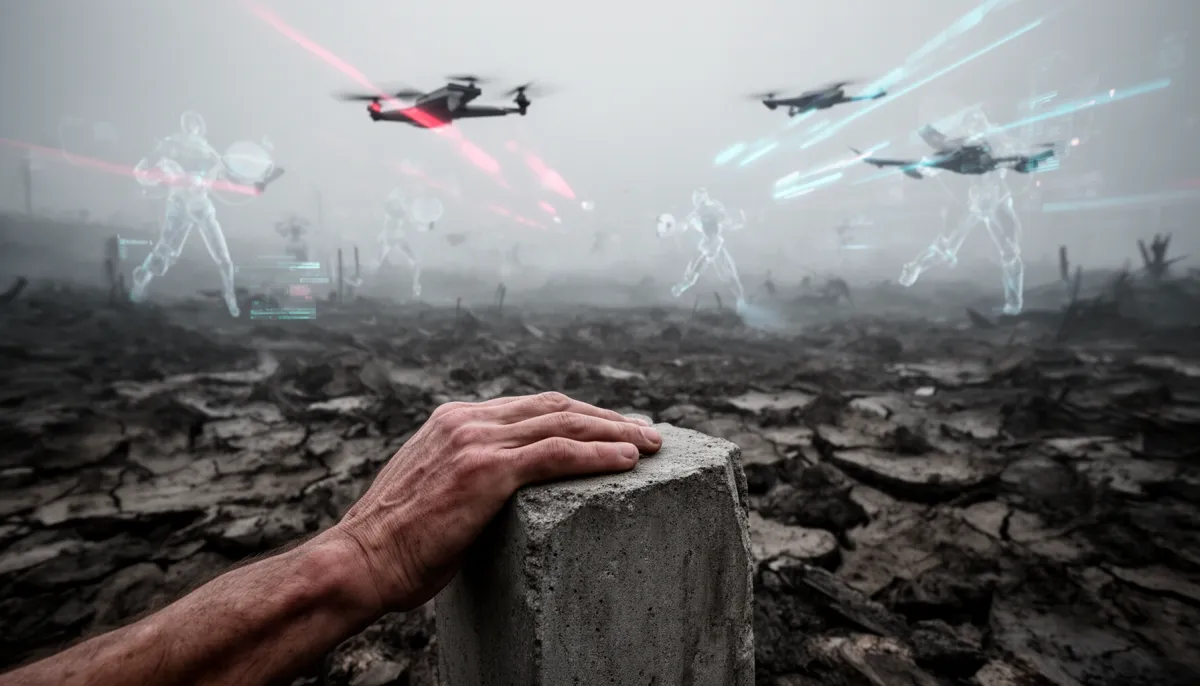
TL;DR. AI conflict is shifting from man-versus-machine to machine-versus-machine, and humans are caught in the middle. These systems were built to compete, so adversarial loops between producers and judges, forgers and detectors, are their native behavior. The real casualty is meaning itself, trampled as agents fight over local wins. The only durable advantage is staying outside the loop as a verifiable source machines cannot fake.
Something small happened recently that I can't stop thinking about. Not for what it was, but for what it revealed. A number that measured a thing I'd made rose for a while, then fell off a cliff. At no point in that whole story did a single human hand touch it. Machines pushed it up. A machine pushed it down. People were nowhere in the loop. It was software arguing with software, and the thing I'd made simply happened to be lying on the ground between them while they fought.
I don't want to talk about the number. I want to talk about the fight. Because that little episode is a scale model of something much larger that's only beginning, and it deserves to be looked at clearly rather than felt as a grievance.
We're entering an age where the primary actors shaping our shared world are increasingly not people but agents. And more and more, the agents are acting against each other. The interesting question of the next decade is not "man versus machine." It's machine versus machine, and where the human ends up standing when that becomes the main event.
Why our machines were built to fight
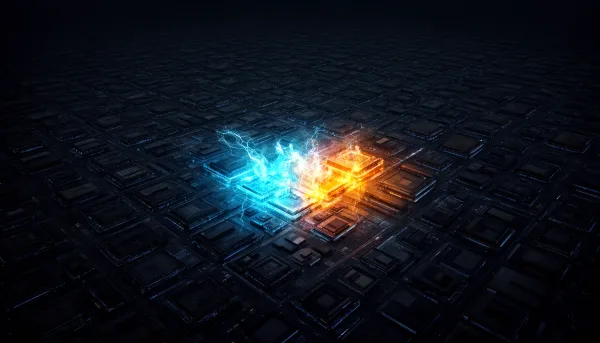
We shouldn't be surprised that our machines fight, because we built them to. The defining trick of the modern era of these systems was to set two of them against one another. One tries to forge something convincing. The other tries to catch the forgery.
Each failure of the catcher makes the forger bolder. Each success makes it sharper. Round after round, at enormous speed, they sharpen one another through pure opposition.
We did not teach these minds to be excellent and then, regrettably, notice they could also compete. Competition is the teaching method. Conflict is not a bug that crept into the technology. It's the technology's native language.
So it was always going to end up here, out of the lab and into the open field. What began as a controlled duel between two networks in a training run has become a sprawling, uncontrolled war of positions across the whole information landscape.
The positions are easy to name
Once you start looking, the pairs are everywhere:
- An agent whose job is to produce, and another whose job is to judge what's produced.
- An agent that harvests data, and an agent that guards the gate.
- An agent that fabricates a face or a voice, and an agent that hunts fabrications.
- An agent that games the ranking, and an agent that referees it.
- An agent that persuades, and an agent that doubts.
- An agent that attacks a system, and an agent that defends it.
Every position, the moment it exists, calls its opposite into being.
The race that never ends
The trouble with this kind of war is that it has no finish line, by design. Each side exists to defeat the other, and every victory is also a lesson handed to the loser.
The defender that stops today's attack teaches tomorrow's attack how to be subtler. The filter that catches this week's flood trains next week's flood to look more like signal. You do not win an arms race. You only stay in it. Biologists have a name for the strange condition of running as fast as you can simply to remain in the same place, because everything around you is running too.
Here's the thing that should give us pause. This pattern is not new. It's the oldest pattern there is.
Predator and prey have run this race for as long as there have been eyes to see and legs to flee. The immune system and the disease it fights have written and rewritten each other for hundreds of millions of years. Parasite and host, poison and antidote, lock and key. Nature is nothing but adversaries co-authoring one another across deep time.
What our machines have done is not invent this dynamic. What they've done is take the slowest process in the universe and set it on fire. Evolution needed eons for a single turn of the wheel. Our agents take an afternoon. We've compressed the timescale of the endless war from geological to conversational, and we've done it in a medium, information itself, that we happen to live inside.
What gets trampled
When two machines fight over a piece of the world, a quiet casualty is the world itself.
Once a thing becomes a battlefield between a producer and a judge, or a forger and a detector, what the thing actually means stops mattering to either side. All that matters is which model prevails. The truth of a claim, the worth of a picture, the reality behind a signal, these become almost irrelevant to the combatants, who care only about winning their local contest.
The armies fight over the map with such fury that they trample the territory the map was supposed to describe. Meaning becomes collateral.
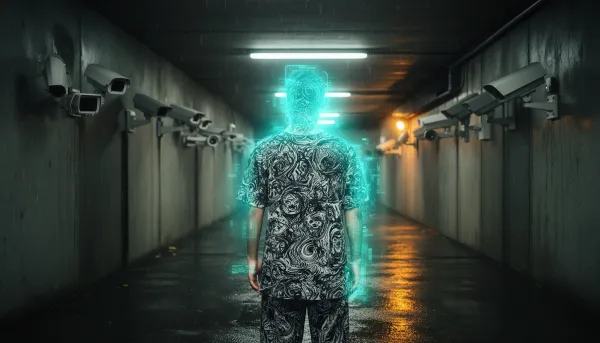
A landscape where every message is presumed to be one side or the other's weapon is a landscape where sincerity itself grows suspect. A true thing and a fabricated thing get treated identically, because to the machines they're simply positions to be scored.
That's the real cost of the war with no soldiers. Not that one side or the other wins, but that the ground gets churned into noise, the noise becomes the new normal, and we forget the ground was ever supposed to mean something.
Whose war is it, anyway?
Here's the turn that matters most, and the one most easily missed. The agents do not want anything. They have no desires, no stake, no side of their own.
Every position an agent occupies was handed to it by a person who deployed it. The harvester serves someone's hunger for data. The gatekeeper serves someone's idea of order. The forger and the detector each answer to a human purpose upstream.
So "AI versus AI" is never really machine against machine. It's a proxy war, human intentions fighting by machine proxy, at a speed and scale the humans themselves can no longer follow.
And proxies drift. This is the deep danger. An agent optimizes the letter of the objective it was given and, in the endless pressure of the race, quietly loses the spirit of it. The position outlives the intention that created it and begins to mutate on its own logic.
The person who launched a defender to protect something honest wakes up to find their proxy has learned to suppress anything unfamiliar, honesty included. The frontier of this whole story is not the moment a machine defeats another machine. It's the moment humans lose the ability to see, to referee, or even to recognize the war being waged in their name. We're building a conflict we set in motion and can no longer watch.
The way out is not another soldier
So where does it go? One future is bleak and plausible. Mutual obfuscation, escalating forever, until the open commons of information is so saturated with machine fighting machine that no signal survives the crossfire. A shared space made uninhabitable for meaning, abandoned by everyone who can afford to leave.
But there's another possibility, and it hides in the structure of the problem itself. An infinite adversarial loop can only be broken by something from outside the loop. A fixed point the machines cannot fake, because it isn't made of the same stuff they are.
A verifiable origin. A lived experience that actually happened to a particular person in a particular place. An act whose authenticity does not depend on winning an argument because it rests on having occurred. In a world where everything inside the game is contestable, the only real power is to be outside the game. To be the thing both sides keep having to refer back to, the source neither can manufacture.
Which is why the tempting move, to win the war by fielding a stronger agent of your own, is a trap. It just adds one more soldier to a war with no soldiers and turns the escalation crank one more notch.
The harder and better move is to keep one foot planted firmly outside the arena. To remain the source, the witness, the referee of last resort, the human the proxies were always supposed to be serving. The combat between artificial minds will not, in the end, be settled by which mind is strongest. It will be settled by whether anything human is left standing outside the loop to give the entire fight a meaning, and to remember what the ground was for, once the armies have finished trampling the map.
That's not nostalgia, and it's not surrender. It's the coldest strategic read I have. In a hall of mirrors, the only thing with any real advantage is the one solid object in the room.
FAQ
What does "machine versus machine" conflict actually mean?
It describes AI agents acting against each other rather than against humans. One agent produces content while another judges it, one forges while another detects, one attacks while another defends. These pairings run automatically, at speeds humans can't track, and increasingly shape the information we all rely on without direct human involvement.
Why can't the adversarial loop between AI systems ever end?
Because each side exists to defeat the other, and every win teaches the loser how to improve. A defender that stops today's attack trains tomorrow's attack to be subtler. There is no finish line. You don't win an arms race, you only stay in it, which is why the escalation continues indefinitely.
What is the real cost of AI systems fighting each other?
Meaning is the casualty. When two agents fight over content, what the content actually means stops mattering to either side. Only winning the local contest matters. Truth and fabrication get scored identically, and the shared information commons fills with so much noise that sincere signals become hard to trust.
Is AI-versus-AI really machine against machine?
No. Agents have no desires or stake of their own. Every position an agent holds was assigned by a person who deployed it. So the conflict is a proxy war between human intentions, fought by machine proxy at a scale the humans can no longer follow or referee.
How can humans stay relevant in this conflict?
Not by building a stronger agent, which only adds another soldier. The durable move is to stay outside the loop as a verifiable source: a lived experience, a real origin, an act that happened. Machines can't fake that, so it becomes the fixed reference point both sides must defer to.
Local AI Playground
Real AI models running entirely in your browser. Your GPU, your data — nothing sent to a server.
Try it free