"AI Slop": Inside the Anti-AI Reaction on Reddit and What the Numbers Actually Say

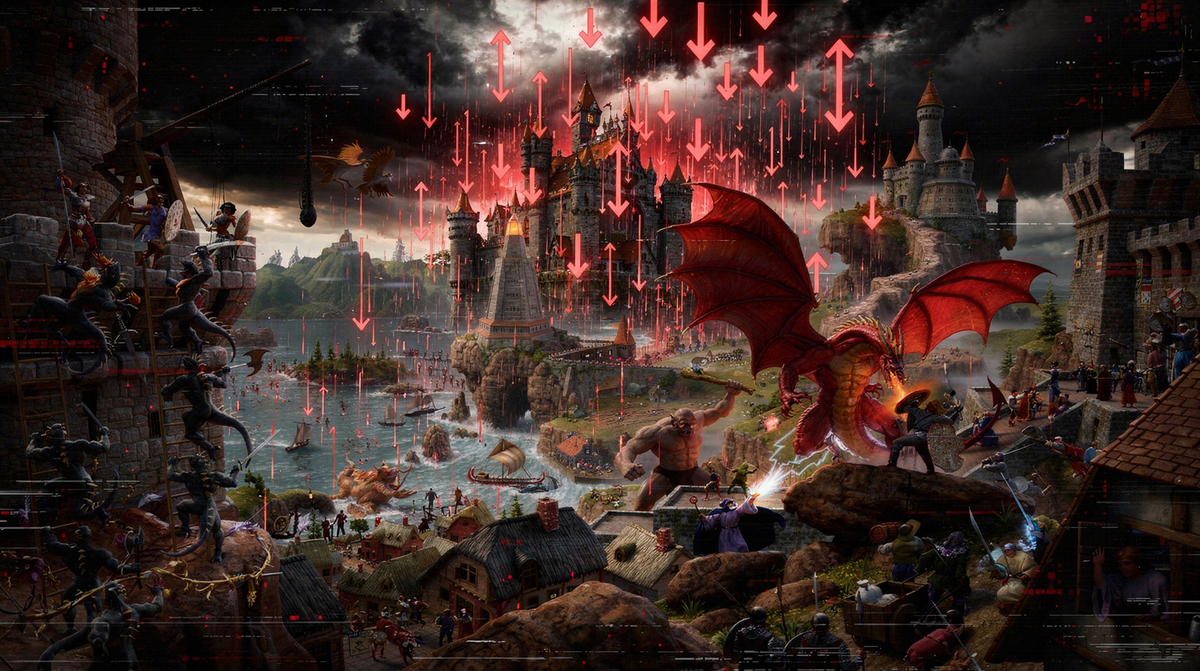
A wallpaper, 7,700 views, 293 votes, and a question about how many of those votes belonged to people.
It started with a wallpaper.
I took the iconic Ultima Online splash art — the one every former player from the late nineties can still picture from memory — and asked Flux 2 Max to reimagine it for 2026. Same composition, same dragon-and-castle silhouette, same sense of a world about to start. Just rendered with the visual language of a contemporary game.
I posted it to r/ultimaonline with a transparent title: "Took the iconic UO wallpaper and asked Flux 2 Max to reimagine it for 2026." No external links. No promotion. No hidden agenda. A homage, signed as such.
Four hours later, the post had 7,700 views, 48 comments, and a public score of 83. The upvote ratio settled at 64.2%. Working backwards from the ratio and the net score, the raw numbers were roughly 188 upvotes and 105 downvotes. Almost three hundred people voted. In a niche subreddit with a few tens of thousands of members, that's a strong response.
But the comments told a different story.
The Anatomy of "AI Slop"
The first negative comment came in within an hour. "AI slop." The second, shortly after: "trash you painted gold — still trash." Over the following day, a steady drip of variations on the same theme. Not arguments. Not critiques of composition, color, or fidelity to the source material. Just the same vocabulary, recycled across different usernames.
Anyone who's spent time on Reddit in 2025 and 2026 recognizes this lexicon. "AI slop." "Soulless." "Theft machine." "Spicy autocomplete." It's a tactical kit — a set of pre-built rhetorical weapons that require zero engagement with the actual content. You don't have to look at the image. You don't have to think about whether the homage works. You just have to drop the phrase and click the down arrow.
I made one mistake worth admitting: I responded sarcastically to the rudest commenter. "I can see that you are a very polite person :)" The reply collected fourteen downvotes before I deleted it. Reddit's culture punishes anyone who engages a troll, even when the troll started it. That's a separate lesson, and one I learned in real time.
The Math of Polarization
Let me show you the math, because the math is where the interesting question lives.
Of the roughly 7,700 viewers, about 293 voted. That's a 3.8% view-to-vote conversion. The Reddit baseline is closer to 1%. The post provoked roughly four times the normal level of reaction.
Of those voters, 64.2% chose upvote and 35.8% chose downvote. In raw numbers: 188 yes, 105 no.
These are not the numbers of organic disagreement. Organic disagreement on Reddit looks like 85/15, or 90/10, with a long tail of comments engaging substantively with the post. The 64/36 split, combined with comments that recycle identical phrases within minutes of each other, looks like something else.
It could be two things. Probably both.
Hypothesis one: organized human communities. There are subreddits and Discord servers dedicated to monitoring and downvoting AI-tagged content. Members get alerts when posts appear in mainstream subs. They show up, vote, drop a one-liner, move on. This is well-documented and visible if you spend any time in r/ArtistHate or its adjacent spaces. The behavior is human. The coordination is real.
Hypothesis two: lightweight botnets. Building a small fleet of Reddit accounts is trivial. Aging them with a few months of innocuous comments costs almost nothing. Wiring them to a script that watches for AI-tagged posts and downvotes within the first hour — when downvotes hurt the most for ranking — costs even less. Reddit's anti-bot systems catch the obvious ones: identical voting patterns from identical IPs, accounts created in sequential batches, comments with measurable embedding similarity. Anything with a minimum of operational hygiene survives indefinitely.
I don't know which of the two I encountered. Probably both, in different proportions. What I know is that the response was not the response of a community reacting to a piece of art. It was the response of a system reacting to a category.
Why This Matters Beyond a Wallpaper
If you're building anything AI-related and you plan to use social platforms for distribution, this is the terrain.
It doesn't matter how thoughtful your work is. It doesn't matter how transparent you are about process. It doesn't matter if you're celebrating the source material or competing with it. The category triggers the response, and the response is faster, cheaper, and more coordinated than your post.
The implications stack up:
You cannot win the comment thread. The vocabulary is pre-built. The downvote math is asymmetric — one troll with three alts has more voting power than ten neutral viewers who quietly enjoyed the post and scrolled on. Engaging the trolls multiplies the damage to your own karma without changing a single mind.
Polarization is the engagement. The same post that absorbed 105 downvotes also generated 188 upvotes and 48 comments, which is what propelled it to 7,700 views. The algorithm doesn't care about sentiment. It cares about activity. You can ride the polarization for reach — but you pay for the ride in karma, morale, and time.
Sub selection is everything. The same image, posted in r/StableDiffusion or r/midjourney, would likely have landed at 85%+ approval with a meaningfully different comment culture. The image didn't change. The audience did. Choosing where to post matters more than what to post.
Containment beats confrontation. Deleting your own sarcastic replies. Disabling inbox notifications on hostile threads. Blocking specific accounts that pattern-match as repeat offenders. These are not signs of weakness. They are the operational hygiene that lets you keep building while the immune system reacts to itself.
What I'm Not Saying
I'm not saying every downvote is a bot. Most aren't. Plenty of human beings have real, considered objections to generative AI, and they have every right to express them by withholding approval. That's how voting works.
I'm not saying r/ultimaonline is a bad community. It isn't. It's a small, passionate group of people who love a thirty-year-old game, and a meaningful percentage of them showed up for a piece of fan art. The post wasn't removed. The mods didn't ban me. The community, on balance, behaved like a community.
I'm not saying the answer is to hide that AI was involved. Transparency about process is non-negotiable. Pretending a generated image was hand-painted would have been worse than any downvote pile-on.
What I am saying is that the social platforms we used to rely on for organic distribution have developed an immune response to the category of work we do. The response is loud, recycled, asymmetric, and at least partly coordinated. It is not going away. Building anything in this space without understanding that terrain is building blind.
The Pattern, Again
This is the fourth time someone at AIpster has sat down to write about coding agents and AI infrastructure, and the fourth time we've ended up writing about the gap between intent and implementation.
Local LLMs failed to compete with cloud APIs because the engineering gap was wider than the cost gap. Visual workflow tools lost to coding agents because the translation gap was wider than the learning curve. Open-core SaaS lost its moat because the patch gap collapsed under two hours of agent-assisted work.
Social platforms are the next gap. The distance between "post a thing" and "reach the right audience" used to be small. Today it's mediated by algorithms tuned for engagement, immune systems tuned against a specific category, and a tooling ecosystem that's shrinking instead of growing.
The work doesn't stop because the terrain is hostile. The work changes. You learn which battles to fight and which to route around. You learn that a 64% approval rating on a polarizing topic is, in fact, a win. You learn to delete your own bad comments faster than the downvotes can compound.
You also learn that the most interesting question about the comments on your post isn't what they said. It's who said them, how many of them were the same person, and what fraction of them were a person at all.
I don't have a clean answer to that question yet. Neither does anyone else. But it's the question that matters now, and the cost of not asking it is showing up in the metrics of every AI-adjacent post on every platform.
The wallpaper is still online. The downvotes are still ticking. Somewhere, a script is still watching for the next post tagged "AI" — and it doesn't care what's in the image.
Postscript: A few hours after publishing the wallpaper, my brother Luiz — also part of AIpster — who happens to work at one of Brazil's most awarded VR/AR studios — got a message from his CEO. Attached: my Reddit post. Caption: 'this guy used AI to update the UO image.' The CEO of a studio building AI-powered VR RPGs had organically found the post that 105 anonymous accounts had spent 8 hours trying to bury. The trolls played to win the comment section. The signal reached the people who actually build the future. There's a lesson in there about which audience is worth optimizing for.
Update at the 24-hour mark: the post now ranks #1 on Google for "uo wallpaper" — a search term with sustained organic volume going back decades. Reddit gave me the initial spike. Google gave me the long tail. While 128 anonymous accounts were busy fighting over the upvote ratio in the first hours, search engine algorithms were quietly indexing the post as the most relevant answer to a query that thousands of people will type in the coming years. The trolls optimized for the comment section. The Google bot optimized for evergreen discovery. One of those audiences leaves after eight hours. The other compounds for years.
André is a co-founder of AIpster. He builds ML models for financial forecasting, self-hosts AI infrastructure, and recently spent a weekend learning that the second-most-expensive line in open-source software is the one you write back to a Reddit troll.
AIpster is an independent AI think tank based in São Paulo, Brazil. Follow us for practical insights on artificial intelligence from practitioners who build, break, and debate AI every day.
Local AI Playground
Real AI models running entirely in your browser. Your GPU, your data — nothing sent to a server.
Try it free