
Modern Luddism: When Anti-AI Bias Replaces Actual Criticism
When a genuine Monet painting was mislabeled as AI art, critics panned it as soulless. The episode is a case study in modern Luddism: reflexive anti-AI bias that overrides honest evaluation of content.

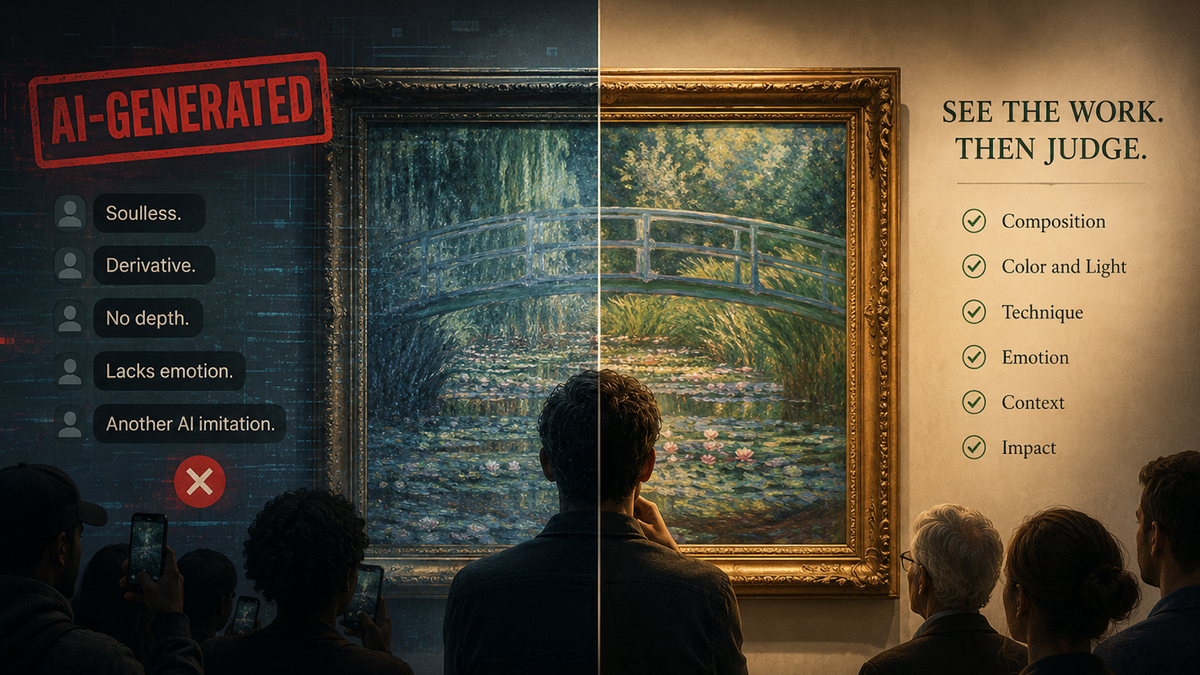
TL;DR: A real Monet painting was mislabeled as AI-generated, and many people criticized it as “soulless” and derivative. The episode shows how anti-AI bias can make people judge the label instead of the work itself. The post argues that criticism of AI is necessary, but it should focus on quality, purpose, accuracy, risk, authorship, transparency, and accountability — not on reflexive rejection. The deeper problem is not that people criticize AI. Criticism is necessary. The problem begins when the assumed origin of a work replaces the analysis of the work itself.
A Monet Painting Failed the Vibe Check
In May 2026, someone shared a genuine Monet painting on social media, presented it as AI-generated art, and asked for critiques. The responses were ruthless. People called it soulless, derivative, lacking depth. The usual complaints that get lobbed at AI imagery.
Then came the reveal: it was a real Monet.
This is what makes the episode philosophically interesting. Were people responding to the painting, or to their belief about the painting? Were they judging form, composition, texture, atmosphere, and emotional effect or were they reacting to the idea that a machine had produced it?
The Monet case exposes a fragile part of human judgment: we often do not evaluate only what we see. We evaluate what we think we know about what we see.
And in the age of generative AI, that distinction matters enormously.
Luddism Didn't Die. It Just Changed Targets.
The original Luddites smashed textile machinery in early 19th-century England. They weren't stupid. They were skilled workers watching their livelihoods get automated, and they fought back the only way they knew how. History tends to mock them, but their fears about displacement were real.
History often uses the word “Luddite” as an insult, but that is too simplistic. Their fears were not imaginary. Their methods were destructive, but their grievances were real.
What's changed is the nature of the target. Each generation of technological disruption produces its own version of Luddism. The printing press threatened scribes. Photography threatened painters. Digital music threatened record stores. The pattern is old enough to be boring, yet it keeps catching people off guard.
Generative AI is the current target. And unlike looms or cameras, AI touches knowledge work, creative work, and identity in ways that feel deeply personal. When a machine can produce an image that looks intentional, write a paragraph that sounds thoughtful, or generate music that evokes emotion, people do not only fear economic replacement. They feel symbolically displaced.
The threat is not only: “Will this take my job?”
It is also: “What happens to the meaning of my work if a machine can imitate part of it?”
That emotional charge makes today's anti-AI sentiment different from past episodes. It's not just about jobs. It's about meaning.
The "Always Against" Revolutionary
Here's the part that will annoy some readers: reflexive opposition to AI has become a social identity.
Being vocally anti-AI signals that you care about artists, about authenticity, about the human spirit. It's a cheap way to position yourself as thoughtful and principled. You don't need to study how diffusion models work. You don't need to understand copyright law or training data provenance. You just need to be loudly, consistently against.
This is the profile of the modern revolutionary, and it costs nothing. No barricades, no risk, no sacrifice. Just a comment that says "AI art isn't real art" under every post, regardless of what the actual content looks like.
The Monet experiment exposed this dynamic perfectly. The critics didn't analyze brushwork, composition, or emotional resonance. They performed opposition. When the label said AI, the performance kicked in automatically.
Being against something by default is not critical thinking. It's the opposite of it.
Prejudice That Supersedes Analysis
Let's call it what it is: there is a pre-judgment against generative AI output that overrides honest evaluation of the content itself.
Consider what happened with the Monet painting. People looked at a masterwork of Impressionism and found it wanting, not because of anything they saw on the canvas, but because of what they believed about its origin. The label "AI" functioned like a cognitive filter, blocking any appreciation before it could form.
This bias shows up everywhere once you start looking for it:
- Writing: Readers who learn a text was AI-assisted will retroactively discover flaws they didn't notice on first read.
- Music: Listeners rate the same composition lower when told AI contributed to it.
- Business communications: People dismiss perfectly functional AI-drafted emails as "lacking a human touch," even when the same phrasing from a human colleague would pass without comment.
The quality of the output hasn't changed. Only the attribution has. That's the definition of bias.
Origin Matters — But Not Always in the Same Way
A mature position on AI cannot pretend that origin is irrelevant.
In art, origin may matter because authorship, intention, historical context, and material process are part of aesthetic value. A Monet painting is not only pigment arranged on canvas. It is also part of a human life, a historical movement, a technique, a tradition, and a cultural memory.
In journalism, origin matters because readers deserve transparency about how information was produced.
In education, origin matters because assessment depends on knowing what the student actually learned and produced.
In law, audit, compliance, and regulation, origin matters because accountability, traceability, evidence, and responsibility matter.
In intellectual property debates, origin matters because training data, licensing, imitation, and economic rights matter.
None of this means AI output should get a free pass. That would be the opposite mistake.
Generative AI produces mediocre results in many contexts. It hallucinates facts. It defaults to generic patterns. It struggles with nuance, cultural specificity, and the kind of intentional imperfection that makes human art interesting. Criticizing bad AI output is perfectly valid.
But the criticism has to be about the output, not about the origin.
A bad AI-generated image is bad because of muddy composition, incoherent anatomy, or empty aesthetics. Not because a machine made it. A good AI-assisted draft is good because it communicates clearly and serves its purpose. Not in spite of the tools used to create it.
Sometimes the use of AI is central to the evaluation. Sometimes it is incidental. Sometimes it creates risk. Sometimes it improves efficiency. Sometimes it should be disclosed. Sometimes it is merely a tool in a broader human workflow.
The intellectual work is knowing the difference.
The right question is never "did AI make this?" The right question is "does this work?"
For practitioners, this distinction matters enormously. If you're using AI tools to accelerate specific workflows (drafting, brainstorming, prototyping, data synthesis), the value of your output should be measured by results. Does the client brief land? Does the report surface the right insights? Does the design communicate what it needs to communicate?
Judging tools by ideology instead of outcomes is a luxury that working professionals can't afford.
Good Results for Specific Cases
The honest position on generative AI in mid-2026 is boring but accurate: it works well for some things and poorly for others.
It's genuinely useful for:
- First drafts and iteration. Getting from blank page to rough draft in minutes instead of hours.
- Translation and localization. Not perfect, but fast enough to be practical at scale.
- Visual prototyping. Generating concept art and mockups before investing in polished production.
- Data summarization. Condensing large volumes of text into actionable briefs.
- Code scaffolding. Building boilerplate and standard patterns so developers can focus on the hard parts.
It's genuinely poor for:
- Factual accuracy without verification. Never trust AI output as a primary source.
- Emotional subtlety. The kind of writing or art that depends on lived experience and intentional vulnerability.
- Legal and regulatory content. The stakes are too high for probabilistic text generation.
Knowing the difference between these categories is the practitioner's job. Blanket rejection and blanket acceptance are both lazy. The useful stance is case-by-case evaluation, which requires actually looking at the output instead of just reading the label.
A Practical Framework for Evaluating AI-Assisted Work
For professionals, the debate cannot stop at ideology. Organizations, creators, educators, auditors, designers, lawyers, and executives need practical criteria.
A more responsible evaluation of AI-assisted work should ask:
| Criterion | Evaluation Question |
|---|---|
| Purpose | What is this output supposed to achieve? |
| Quality | Does it achieve that purpose well? |
| Accuracy | Are factual claims verified against reliable sources? |
| Transparency | Should AI use be disclosed in this context? |
| Risk | What harm could result if the output is wrong? |
| Authorship | What was the human contribution? |
| Accountability | Who is responsible for the final result? |
| Evidence | Can the process, data, assumptions, or sources be reviewed? |
| Originality | Does the output add meaningful value or merely imitate patterns? |
| Governance | Were appropriate policies, controls, and review mechanisms followed? |
This approach avoids both extremes.
It rejects the naïve view that AI output is valuable simply because it is efficient. But it also rejects the equally naïve view that AI output is worthless simply because AI was involved.
The right stance is not blind acceptance or reflexive rejection. It is disciplined evaluation.
The Real Cost of Reflexive Opposition
When entire communities adopt anti-AI bias as their default position, the cost isn't just bad comment sections. It's missed opportunity and distorted discourse.
Teams that refuse to experiment with AI tools because of cultural pressure fall behind teams that evaluate tools pragmatically. Organizations that ban AI use without understanding specific use cases lose efficiency they could have captured. Creators who dismiss AI-assisted workflows wholesale may find themselves outpaced by peers who integrate them thoughtfully.
And on the discourse side, reflexive opposition drowns out the real criticisms that need attention: copyright concerns, labor displacement, environmental costs of training large models, concentration of power in a few companies. These are serious issues. They deserve serious analysis, not the performative outrage that currently dominates the conversation.
The Luddites of the 1800s had legitimate grievances buried under their machine-smashing. Today's anti-AI movement has legitimate grievances buried under reflexive hostility. In both cases, the emotional response made it harder, not easier, to address the real problems.
The real test of critical thinking in the age of AI is not whether we can detect the machine. It is whether we can still judge clearly after we think we have detected it.
The Central Lesson
The Monet episode does not prove that AI can replace human art. It does not prove that machines possess intention, consciousness, or aesthetic understanding. It does not settle the debate over authorship, originality, or creative labor.
What it does show is more subtle and perhaps more important.
It shows that human judgment is vulnerable to labels.
It shows that people can mistake attribution for analysis.
It shows that the belief that something was made by AI can change what people think they see.
And that should concern anyone who cares about critical thinking.
The challenge of the AI age is not simply learning how to detect machine-generated content. It is learning how to judge clearly after we think we have detected it.
Because the real test of critical thinking is not whether we are for or against AI.
The real test is whether we can still see the work in front of us.
FAQ
What is modern Luddism in the context of AI?
Modern Luddism refers to the reflexive opposition to artificial intelligence technologies, mirroring the original Luddite movement that targeted textile machinery in 19th-century England. Today's version focuses on generative AI tools and often manifests as blanket rejection of any AI-produced or AI-assisted content, regardless of its actual quality.
What happened with the Monet painting that was presented as AI art?
In May 2026, someone shared a genuine Monet painting online and told viewers it was AI-generated, then asked for critiques. Commenters overwhelmingly criticized the work as soulless and lacking depth. When the poster revealed it was actually a real Monet, the episode demonstrated that people were judging the label, not the art itself.
Is all criticism of AI-generated content just bias?
No. Plenty of AI output deserves criticism because it's genuinely mediocre, factually wrong, or aesthetically empty. The bias problem arises when people reject content solely because they believe AI created it, without evaluating the content on its own merits. Legitimate criticism should focus on the quality and purpose of the output, not on the tool used to produce it.
Can generative AI produce good results?
Yes, for specific use cases. Generative AI works well for first drafts, translation, visual prototyping, data summarization, and code scaffolding. It performs poorly for tasks requiring factual precision without verification, emotional subtlety, or high-stakes legal and regulatory content. The key is matching the tool to the appropriate task.
How should practitioners approach AI tools without falling into bias?
Evaluate outputs based on whether they achieve their intended purpose. Ask "does this work?" instead of "did AI make this?" Experiment with AI tools in low-risk contexts, measure results, and scale what proves effective. Avoid both reflexive rejection and uncritical acceptance.
Local AI Playground
Real AI models running entirely in your browser. Your GPU, your data — nothing sent to a server.
Try it free