Qwen 3.8 27B Is Going Open Weight, and That Matters More Than the Max Model
Qwen 3.8 27B may be Alibaba's most important release—not because it's the biggest, but because it brings frontier-adjacent AI to a single consumer GPU. As local models improve, owning AI is becoming a realistic alternative to renting it.


TL;DR. Qwen 3.8 27B is Alibaba's next open-weight release, arriving alongside the datacenter-scale Qwen 3.8 Max. The Max grabs headlines with frontier benchmarks, but the 27B model is the one that runs on a single prosumer GPU. Its predecessor, Qwen 3.6 27B, already beat Claude Haiku and edged toward Sonnet 4.6 quality. If the 3.8 version holds that trend, local frontier-adjacent AI stops being a promise.
The open-weight flood is real, and it's accelerating
We've been tracking release cadence for months, and the pattern is hard to ignore. In a matter of weeks we've seen GLM 5.2, Kimi K3, and DeepSeek V4 Flash.
These are not toy models. These models are really capable of trading blows with offerings from Anthropic, Google, and OpenAI. And their release cadence is moving faster than most teams can evaluate.
About two weeks ago, we published an article on Qwen 3.8 going open weight. But now we have a development that makes this release much more impactful.
Meet Qwen 3.8's little brother
The flagship Qwen model is out of reach for everyone except organizations with datacenter-scale infrastructure. Alibaba however revealed that they'll also release a smaller model that caused a stir in the community.
Qwen 3.8 27B is that smaller model, and the size is the whole point. Twenty-seven billion parameters, when sensibly quantized, it fits in hardware that a hobbyist or a gamer already owns today.
Think about what that unlocks in practice:
- No per-token bill. Your marginal cost per request drops to electricity.
- No data leaving your machine. For regulated or sensitive workloads, that's not a nice-to-have, it's the requirement.
- No rate limits or queue times. The model runs at your latency, on your schedule.
- Full control of the weights. You can fine-tune, prune, or serve it however you like.
A datacenter model gives you access to capability. A local 27B model lets you own it.
Why the 27B class already earned my trust
I'm not speculating in a vacuum here. The predecessor tells the story.
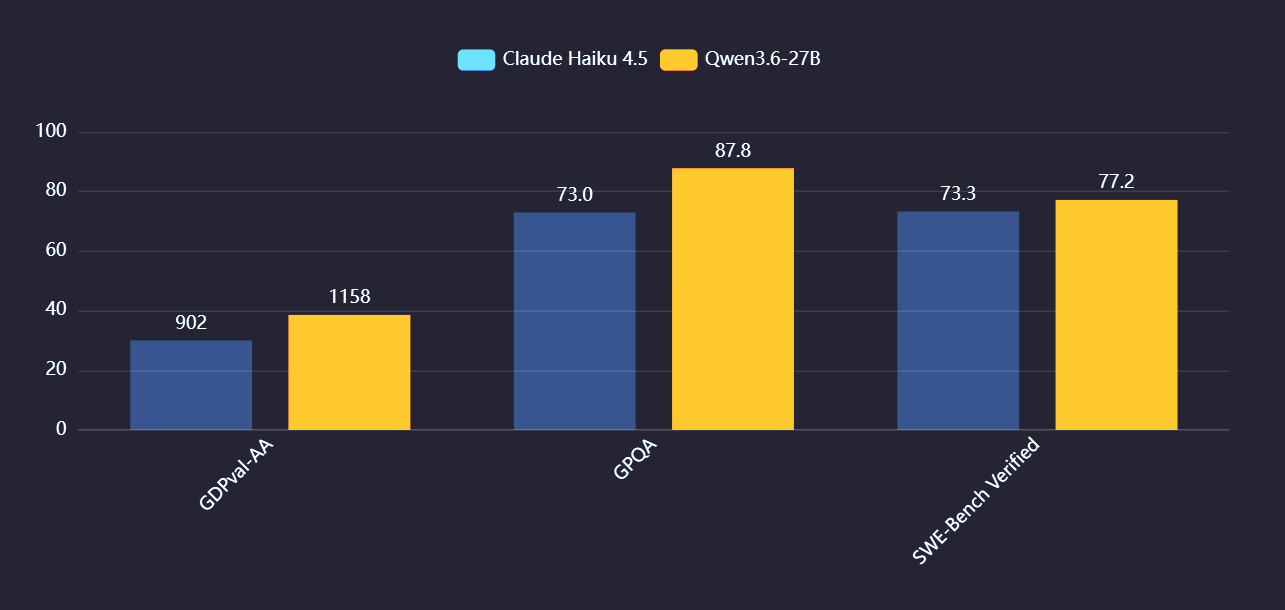
Qwen 3.6 27B is already a remarkable model for its size. In my own testing and in the broader community's, it comfortably clears Claude Haiku on most practical tasks. Reasoning, instruction following, structured output, code generation. It's not close in the categories that matter for day-to-day work.
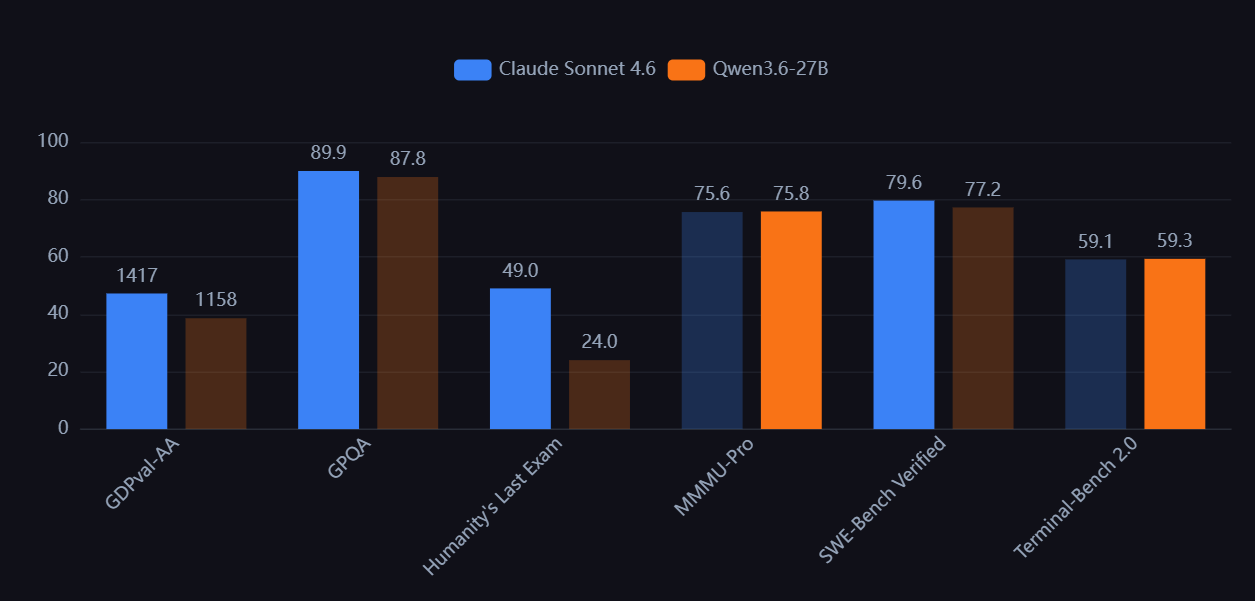
More surprising is how near it gets to the tier above. On several workloads, Qwen 3.6 27B lands within reach of Sonnet 4.6 quality. Not identical, but close enough that on many production tasks, you often couldn't tell which model produced the output.
One hypothesis I've discussed before is these Qwen models, effectively eliminated the niche Haiku occupied. If an open-weight model already meets or exceeds that quality on many practical tasks, the incentive to maintain a separate small hosted model becomes much weaker.
The takeaway: the 3.6 27B already beat Haiku and approached Sonnet 4.6. The interesting question is not whether the 27B class is good enough. It's how much better 3.8 makes it.
What the community is already saying
The signal isn't just from Alibaba's own channels. Over on r/LocalLLaMA, the 3.8 27B announcement landed right next to the Max reveal, and the local-AI crowd reacted exactly the way you'd expect. The people who actually run these models on their own machines skipped past the flagship almost immediately and started asking about quantization, VRAM requirements, and context length for the 27B.
That's the tell. The practitioners who care about running models rather than reading about them already know which release is theirs.
What I expect from Qwen 3.8 27B, and why you should care
So here's my provocation. If Qwen 3.6 27B was almost Sonnet 4.6, what does 3.8 27B become?
The honest answer is that a single generation jump in this class has historically bought meaningful gains. Better reasoning, cleaner long-context behavior, stronger coding, fewer of the small failures that make you reach for a bigger model. If 3.8 27B moves the needle the way 3.6 did over its predecessor, the "almost Sonnet" caveat may quietly disappear.
Now picture the consequence. A model that matches a current-tier hosted frontier model, running on hardware you can buy today, with weights you own outright. Why rent when you can own capability that's good enough?
I'm not claiming 27B will dethrone the true frontier. But the top is not where most work happens. Most work happens in the broad middle, and the middle is exactly where the local 27B class is winning. As I wrote before, we drive Hondas to take our children to school, not Porsches.
FAQ
What is Qwen 3.8 27B?
Qwen 3.8 27B is an open-weight large language model from Alibaba's Qwen team, expected to release alongside the much larger Qwen 3.8 Max. The "27B" refers to roughly 27 billion parameters, a size deliberately chosen to run on consumer and prosumer hardware rather than a datacenter. It is the local-friendly member of the Qwen 3.8 family.
How is Qwen 3.8 27B different from Qwen 3.8 Max?
Qwen 3.8 Max is the flagship model built for peak benchmark performance, and it requires datacenter-class or multi-GPU hardware to run at full quality. Qwen 3.8 27B is far smaller, which lets it run on a single high-end GPU while still delivering strong results. Max optimizes for maximum capability; the 27B optimizes for capability you can actually own and run yourself.
Can Qwen 3.8 27B really run on consumer hardware?
Yes. A 27-billion-parameter model, quantized appropriately, fits on a single high-end consumer or prosumer GPU. This removes per-token costs, keeps your data on your own machine, and eliminates rate limits and queue times, which is why the local-AI community treats the 27B release as the important one.
How good was the previous Qwen 3.6 27B?
Qwen 3.6 27B already outperformed Claude Haiku on most practical tasks and approached Sonnet 4.6 quality on several workloads. For a model of its size that runs locally, that put it in a category most people assumed required a hosted frontier API. It set the baseline that Qwen 3.8 27B is expected to improve on.
Why does an open-weight 27B model matter for my business?
A locally runnable model that approaches hosted frontier quality changes the cost and control equation for a wide range of applications. You own the weights, pay only for electricity, keep data private, and avoid vendor rate limits. As each generation narrows the gap with paid APIs, the case for renting capability you could instead own gets weaker.
Local AI Playground
Real AI models running entirely in your browser. Your GPU, your data — nothing sent to a server.
Try it free