
Qwen-AgentWorld: An Agent Focused Model That Punches Above Its Compute Bill
Qwen's new AgentWorld-35B-A3B highlights a growing trend in local AI: specialized, self-hostable models competing with frontier systems on targeted workloads. The question is increasingly not "Which model is smartest?" but "Which model is best for the job?"


The local LLM landscape is becoming increasingly difficult to ignore.
Just in the last few weeks, we've seen GLM-5.2 emerge as one of the strongest open-weight models available, with benchmark results that place it among frontier models and a massive context window. More importantly, it is another example of a model optimized for long-horizon coding and agentic workflows rather than trying to be everything for everyone.
Yesterday, Qwen released Qwen-AgentWorld-35B-A3B, a 35B MoE (Mixture-of-Experts) with only ~3B active parameters per token.
The architecture is not novel: I've been using Qwen3.6-35B-A3B as my daily driver for quite some time, running entirely on consumer hardware. That's the beauty of these A3B models: you get access to a 35B-parameter model while only activating roughly 3B parameters per token. You still need enough memory to hold the full model, but the compute requirements are surprisingly manageable. In practice, this puts the model within reach of enthusiast-grade hardware rather than requiring datacenter infrastructure.
However, it is the benchmark claims are what caught my attention.
According to Qwen, AgentWorld outperforms several frontier models on its newly introduced AgentWorldBench, a benchmark covering MCP usage, search, terminal tasks, software engineering, Android, web interaction, and OS-level workflows. On their published results, AgentWorld-35B-A3B scores 56.3 overall, ahead of Claude Sonnet 4.5 (52.4) and Claude Sonnet 4 (49.0).
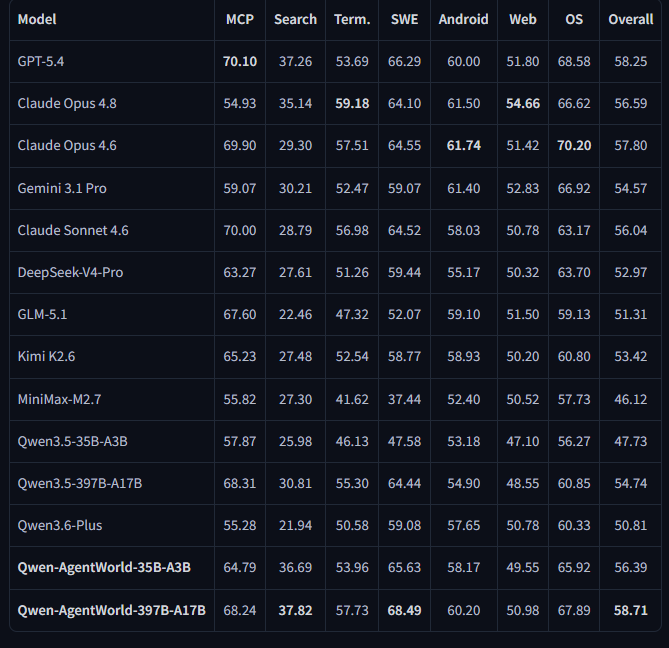
What is perhaps even more surprising is the company it keeps. On the same benchmark, it is only slightly behind much larger frontier models such as Claude Opus 4.5 (63.1) while substantially outperforming several other flagship models, despite being a self-hostable 35B MoE.
I also think this reflects a broader trend in AI. Instead of throwing ever-larger general-purpose models at every problem, we're starting to see highly specialized models emerge for specific workloads. Microsoft's FastContext focuses on repository exploration and codebase understanding. GLM-5.2 focuses heavily on long-horizon coding and agentic workflows. AgentWorld appears to be making a similar bet for autonomous agents.
The question is no longer just "What is the smartest model?"
It's increasingly "What is the best model for this particular job?"
A few years ago, a model claiming to compete with or outperform Claude on agent benchmarks would have implied racks of GPUs.
Today, the claim is that you can run it on a beefy desktop.
Whether those benchmark numbers hold up in the wild remains to be seen.
Stay tuned !!!
P.S. For more news like this, don't forget to sign our newsletter (it is free as a beer).
FAQ
What does A3B mean in Qwen-AgentWorld-35B-A3B?
A3B means roughly 3 billion parameters are active per token, even though the model holds 35 billion total. It's a mixture-of-experts design where a router selects a small subset of the network for each token, giving the inference speed of a small model with the capacity of a larger one.
How much memory do I need to run it?
You need to fit all 35 billion parameters in memory, not just the active 3 billion. At 4-bit quantization that's roughly 18 to 22 GB of weights plus context overhead, which fits on a single high-end consumer GPU or a well-specced Apple Silicon machine. The active-parameter savings apply to compute, not memory.
How is it different from a regular instruct model?
The AgentWorld name signals training focused on agentic tasks: tool calling, function use, and multi-step task completion inside a loop. A standard instruct model optimizes for good single answers, while AgentWorld is shaped to operate as part of an agent system that makes many sequential calls.
Are those number real ?
These are self proclaimed benchmark with a novel benchmark tool. While the benchmark tool has been open-sourced. You must take the number with a grain of salt.
Local AI Playground
Real AI models running entirely in your browser. Your GPU, your data — nothing sent to a server.
Try it free